+ -

Pages

Tuesday, June 27, 2006

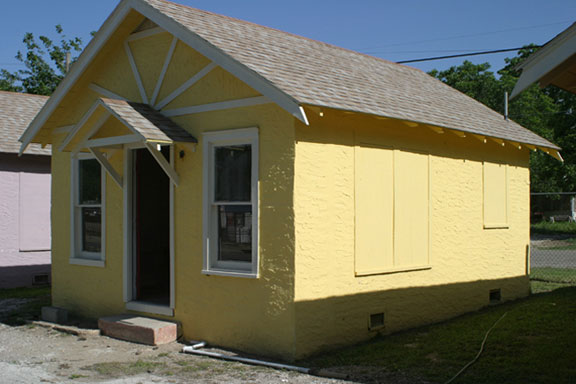
The Bungalows Project


The Bungalows Project
Contemporary Art Month San Antonio


Cauleen Smith, testsite
Ali Fitzgerald, Art Palace
Heather Johnson, The Donkey Show

Jared Steffensen, Okay Mountain

Opening: June 30, 6 pm ~ 12am
On view through: June 30 ~ July 31
Closing: July 28, 3 pm ~ 12 am

open: Saturdays and Sundays 12 ~ 6 pm and by appointment


Bungalow Project | 4302 South Presa | San Antonio, Texas, 78223
camsanantonio.org | info@camsanantonio.org

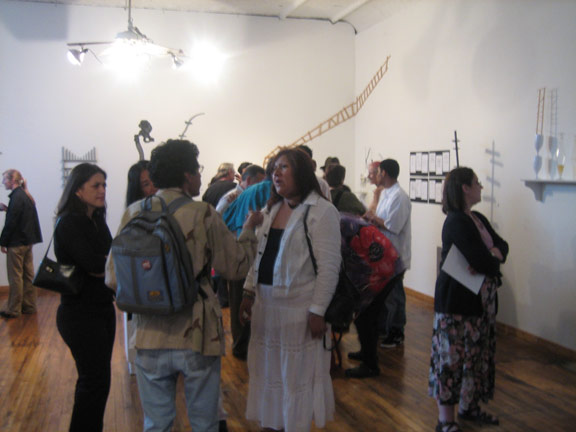
Contemporary Arts Month (CAM) 2006 kicks off June 30th with The Bungalow Project. Art spaces and curators from around the country have been asked to mount an exhibition in one of eight bungalows motel rooms at Johnson Courts Motel 3. Four Austin spaces have chosen four Austin-based artists: testsite a project of Fluent~Collaborative presents work by Cauleen Smith; The Donkey Show, Heather Johnson; Art Palace, Ali Fitzgerald; and Okay Mountain, Jared Steffensen. Other invited spaces include 500X from Dallas, duchamp ta mere from Portland, Polvo from Chicago and Jack the Pelican from Brookyn. To find out more about this and other upcoming CAM events, checkout the CAM calendar online.

FLUENT~COLLABORATIVE is a speculative non-profit initiative, based in Austin, Texas, established to increase awareness of new developments in the contemporary visual arts and the ideas and issues that inform contemporary culture. FLUENT~COLLABORATIVE is a laboratory for these ideas—a place where a critical and creative mix of visual, media and performance artists join authors, filmmakers, musicians, architects, poets and other diverse communities outside of the arts to enable a new awareness and sophisticated discerment of changing thought and culture around the world.

...might be good is a contemporary art biweekly produced by Fluent~Collaborative that reaches over 4,000 international subscribers via email and at our website: www.fluentcollab.org/mbg. An independent voice based out of Austin and San Antonio, with a team of writers covering exhibitions from Paris, France to Marfa, Texas, …might be good encourages close looking, smart writing and brave thinking about art. info@fluentcollab.org

Stay tuned for FLUENT~COLLABORATIVE's latest endeavor, NESTSITE, a blog with postings about everything we find exciting in contemporary art by contributors based in Austin, New York, London, Paris, Berlin, Tokyo and other hotspots of artmaking.
5 : : : P O L V O : : :: June 2006 The Bungalows Project Contemporary Art Month San Antonio Cauleen Smith, testsite Ali Fitzgerald, Art Palace ...

Saturday, June 24, 2006

Elizam Escobar interview in la raza newspaper

El arte como arma de liberación

Una ovación de pie por parte de la comunidad puertorriqueña que asistió al estreno de “Spark”, una obra de Tato Laviera y Batey Urbano, recibió el artista, teórico y maestro Elizam Escobar, como reconocimiento a su trayectoria plástica y el rol histórico que representa como uno de los íconos de la resistencia boricua.

Mercedes Fernández
Especial La Raza


En su hablar pausado se denota el ejercicio reflexivo de 20 años en prisión que marcaron profundamente su perspectiva artística y la reafirmación de sus convicciones políticas.

Después de desempeñar la dirección del Departamento de Pintura de la Escuela de Bellas Artes en San Juan, actualmente sigue trabajando como profesor del mismo departamento y en esta visita a Chicago, una de las tantas después de su excarcelación en 1999, viene a exhibir su obra en el espacio que le brinda el colectivo Polvo en Pilsen.

-¿Qué nos trae en esta nueva visita a Chicago?
Esta es una exhibición en la que el tema principal surge de una serie de dibujos que yo hice en la prisión de Oklahoma en los noventas y que son imágenes que representan las rejas carcelarias y cómo yo veía que esas rejas se convertían en una imagen de liberación.
De esos dibujos hice una serie de 18 o 20 con la perspectiva de hacer una escultura usando rejas de verdad, proyecto que no he culminado aún y cuyo avance son éstos dibujos que presentaré en Polvo.

La materialización de éstas ideas son construcciones mixtas en la que es posible percibir el sentido de una prisión cerrada “con el fin de mantener aislados a sujetos antisociales o a quienes son un peligro para el sistema social” y, al mismo tiempo, presentar la idea de una prisión abierta que para el artista se refleja en la la vida entre las rejas de protección con que se encierran los habitantes de una ciudad.

“Salí de la prisión después de casi 20 años y al llegar a Puerto Rico sentía que era una prisión en otro sentido porque la gente vive con rejas por el índice de criminalidad, por la cultura del miedo y toda esa serie de cosas que se han ido desarrollando en la vida civil y social, determinada de una forma enfermiza por la situación económica, el crimen, la cultura de la droga, etc.”, dijo Escobar, nacido en la ciudad de Ponce, Puerto Rico, en 1948.

-¿Cómo ve el movimiento artístico latino en los Estados Unidos?
No puedo hablar en propiedad cómo se desarrolla el arte latino en los Estados Unidos, aunque sé que hay unas vertientes que tratan de rescatar elementos de la identidad cultural y hay otras corrientes que están más en el espacio global.

Yo creo que eso está pasando en todos sitios y es importante cómo se hace una relación entre el aspecto de la localidad y cómo uno de ahí se desplaza o alza para que ese arte tenga un nivel más universal, que es a lo que aspira todo arte.

-¿Sigue siendo el arte un instrumento de transformación de la conciencia?
Estoy interesando en cómo el arte se convierte en un arma de liberación, de crear conciencia, pero entiendo que siempre tiene su propia dialéctica y su propia especificidad y no puede ser solamente para expresar las ideas, tiene que haber un diálogo con los sociólogos, los políticos, las comunidades.

Pero el arte tiene una especificidad que es el nivel simbólico, y sin él no creo que pudiésemos tener un sentido de la existencia. Y creo que ese nivel simbólico también es utilizado por otras ideologías para mantener el status quo, para crear ilusiones falsas.

Para mi el arte es como el límite de la libertad, es el pensamiento y esa práctica de la libertad que surge del sentido de la necesidad de entender lo que es la necesidad, la conciencia de lo que es necesario para allí alzarse en libertad.

-Un auditorio mayormente joven y también veteranos de los ‘motines del 66” del barrio puertorriqueño, se puso de pie para ovacionarlo ¿ qué reflexión le provoca este hecho?
He estado varias veces en Chicago y no es la primera vez que ésto sucede. Creo que es la manera de expresión del reconocimiento, no solamente al individuo sino a lo que uno simboliza o representa en esta lucha que es real y que tiene distintos niveles.

Es una lucha histórica, una lucha que ha generado las expresiones más significativas, culturales y artístico-políticas, y es una forma de entender esa historia y de lo que simboliza la lucha no solamente por la autonomía de la comunidad puertorriqueña en la diáspora en los Estados Unidos, sino también la sobreviviencia como nacionalidad y como cultura.
El arte es como la práctica que puede enlazar esos tiempos que llamamos el pasado, presente y futuro, y que mantiene una memoria dinámica, cuestionadora y crítica sobre lo que nosotros somos primero, para después hacer algo sobre lo que nos han impuesto y lo que hemos heredado.

Símbolo de la revolución
Egresado de la Escuela de Artes Visuales de la Universidad de Puerto Rico y del New York City College, Museo del Barrio y el Art Students League en Nueva York, Escobar es considerado como un símbolo de la revolución, además de un renombrado poeta y pintor .

Escobar fue capturado el 4 de abril de 1980, y junto con otros de sus compañeros se le condenó a 68 años de prisión por el cargo de conspiración sediciosa. Durante su captura, juicio y encarcelación, el artista mantuvo su posición como prisionero de guerra en abierta confrontación a la ocupación ilegal de los Estados Unidos sobre la isla.

A Escobar le ha tocado exhibir en galerías como The Axe Street Arena, Kalpulli, Casa de Arte Calles y Sueños, Rafael Cintrón-Ortíz Cultural Center en Chicago; The Dissident Voices Gallery de Filadelfia, entre otras.

La inauguración de su exhibición Polvo tendrá lugar el viernes 23 de junio de 6 a 10 p.m. La exposición continuará hasta el 15 de julio del 2006 . La admisión es libre. © La Raza
5 : : : P O L V O : : :: June 2006 El arte como arma de liberación Una ovación de pie por parte de la comunidad puertorriqueña que asistió al estreno de “Spark”, una obra de T...

Jesus Macarena featured in La Raza newspaper

El arte innovador de Jesús Macarena-Avila

Quién diría que los diseños de azúcar en pan dulce elaborados meticulosamente por su padre determinarían en parte el destino artístico del niño Jesús Macarena Ávila, hoy por hoy uno de los artistas latinos jóvenes más representativos de su generación .

Mercedes Fernández
Especial La Raza


Las excursiones a los museos de San Luis Potosí -de donde sus padres son originarios-, así como las largas horas dibujando en papel de molde y haciendo prospectos de esculturas en masa de pan, calaron hondo en la sensibilidad del futuro artista y actual co-director de Polvo, un colectivo de creadores que brinda un espacio alternativo de exhibición y educación para el arte en Pilsen.

Nacido en Texas, Macarena es un personaje en constante búsqueda de su identidad, inquietud expresada en la versatilidad de su obra que va desde la pintura en acuarela de sus primeros años, a las innovadoras imágenes creadas digitalmente, pasando por instalaciones, altares y ofrendas en las que cada detalle, material u objeto tiene un significado a nivel simbólico.
Con ocasión de sus próximas exhibiciones en St. Louis, Missouri, y Belén, en Palestina, Macarena relató pasajes de su vida personal, los hechos que inspiran su obra y su trabajo como artista comprometido con la realidad de su tiempo.

“De niño me interesó la historia y me la pasaba con mis padres en los museos. Siempre me llamó la atención la cultura prehispánica que en San Luis Potosí era la Huasteca”, dice Macarena, egresado de la Escuela del Instituto de Arte de Chicago y del Vermont College de la Universidad de Norwich.

“Empecé pintando carnavales y seres de otros planetas, en un medio familiar donde todos los miembros eran aficionados ya sea al baile o a la música y la artesanía”, relata Macarena, quien recibió su primer reconocimiento como artista aficionado a la edad de 11 años.

“Dejé la escuela”
Hechos de su vida personal en su adolescencia, como la separación de sus padres y la muerte de su madre marcaron la primera etapa de su obra, en la cual la familia es el centro de su temática.

“Fue la época en que mis padres se separaron , mi madre contrajo cáncer y tuve que dejar la escuela para dedicarme a cuidarla. Esa experiencia me permitió aprender mucho sobre el cuerpo de la mujer”, recuerda Macarena.

A finales de los 80's se mudó a Chicago abandonando temporalmente su afición por el arte. Animado por el espíritu luchador de su madre, Macarena se decidió a terminar la secundaria por correspondencia y ya en los 90's ingresó a la Escuela de Artes Plásticas del Instituto de Arte de Chicago, donde aprendería las técnicas e historia del arte, pero donde también reafirmaría su vocación por la educación y la extensión del arte a las minorías.

“Fue en esa etapa que me relacioné con artistas jóvenes de Pilsen, en una época en que escaseaban las galerías. Fueron mis primeros encuentros con Giselle Mercier, René Arceo y Miguel Cortez, entre otros”, dijo.

Macarena trabajó en el Museo Mexicano de Bellas Artes bajo la dirección de la artista panameña Giselle Mercier y empezó a participar en exposiciones colectivas en los 90's en el espacio denominado Calles y Sueños promovido por el artista José David Quiñones. “Era uno de los pocos lugares -sino el único en Pilsen- que era como una meca de un pensamiento con presencia política metido con la expresión colectiva”, dice Macarena en un español por momentos difícil de seguir.

“Entre espacios”
Así se titula la exposición de Macarena, que tendrá lugar del 14 de julio al 31 de agosto en la Galería Bellas Artes de St. Louis, Missouri. “Mis piezas tratan de explorar la idea de la memoria personal en relación a la idea de raza y clase”, comenta respecto a la obra a exhibirse.
Macarena indicó que la comunidad hispana en St.Louis no es numerosa y esta muestra es importante para dar a conocer el arte de los latinos en los Estados Unidos como una creciente minoría cultural y políticamente activa.

Al mismo tiempo, la Universidad de St. Louis presentará una conferencia a cargo de Macarena en preparación de la exhibición “Material Acumulado; Altares contemporáneos y Ofrendas” con Galería Visio a llevarse a cabo en noviembre del 2006.

Al artista le llama la atención las fotos que los jóvenes toman desde sus teléfonos celulares y sus posibilidades artísticas. “En el siglo XV o XVI la gente no tenía recursos para contratar un artista que los retrate y ahora cualquier persona que gane menos de 10 mil dólares al año puede tomar fotos con su celular y enviarlas a cualquier parte del mundo”, dijo Macarena.
Alrededor de ocho imágenes digitales impresas de una dimensión de 3 por 4 pies serán apreciadas en esta exhibición. “Son imágenes creadas a partir de fotos tomadas con celulares cuya resolución es muy baja. Algunas tienen composiciones muy interesantes y reflejan estos tiempos en que andamos metidos en lo digital y dependientes cada vez más de la tecnología como el celular y la internet”, agregó.

Una agenda bastante agitada lleva a Macarena a otra exhibició, pero esta vez en Belén, Palestina, en julio, donde mostrará sus trabajos en formato digital conjuntamente con alrededor de 100 artistas de todo el orbe.

Esta será una exposición itinerante e incluirá países como Alemania, Italia y Argentina y Polonia. El titulo de la exhibición es “://selfportrait: a show for Bethlenem”, y tendrá lugar en Al Kahf Art Gallery del International Center of Bethlehem. © La Raza
5 : : : P O L V O : : :: June 2006 El arte innovador de Jesús Macarena-Avila Quién diría que los diseños de azúcar en pan dulce elaborados meticulosamente por su padre determi...

Friday, June 23, 2006

photos from tonight's opening: Elizam Escobar @ polvo


Artists Jaime Mendoza, Elizam Escobar and Edra Soto


Writer/poet Leon Leiva and artist Ricardo Diaz
5 : : : P O L V O : : :: June 2006 Artists Jaime Mendoza, Elizam Escobar and Edra Soto Writer/poet Leon Leiva and artist Ricardo Diaz

Tuesday, June 20, 2006

a night of short videos from the Czech Republic

Things are not what they seem

/FaVU video 2004-2006: videos by students from Faculty of Arts in Brno (Czech Republic)/

Selection made for annual Summer Film School which will take place in July 2006 in Uherské Hradiště (Czech Republic) – and thus will have its premiere in Polvo.

Curator: Lenka Dolanová

Friday June 30 from 7pm-9pm

New worlds can be created in a different ways with the use of video. Although its original utopian subversive aspect already disappeared, it retained a strong personal taste. It still has that positive flavor of amateurism and certain lightness. It is still more or less laughed at alternative of film. “Man poetically dwells on the earth,” says Friedrich Hölderlin quoted by Martin Heidegger. It is necessary to create our own world which will be worthy of us and of which we will be worthy. Expanding our own space and description of our form of dwelling is essential in the world so much replete with technology. The familiar things disappear because their objectivity is too obvious; we try to save or rediscover them by making them part of our personal poetic mythology. Our ideas rearrange themselves into the world game. But the things in this game go adrift. We are afraid that they might be mere things. We are afraid that they might not be mere things. Things are not what they seem.

There is a castle on the hill above Brno called Špilberk (in Czech language) or Spielberg in German, which can be translated as “playful hill”. Castle-Play was but later transformed in one of the most solid prison fortresses. In 1822 the special cells for political prisoners were build in its north wing. Italian poet Silvio Pellico belonged to the revolutionary group Carbonari which was fighting for liberal united Italy, and spent several years in Špilberk prison; he later described his experiences in the book My prisons. Another group of political prisoners was later formed by nearly 200 Polish revolutionaries, participants of Krakow uprising in 1846, and last time was Špilberk transformed into prison during first and second world wars, when that time Czech patriots were dwelling there. Playful castle as a prison-like dwelling for poets and revolutionaries. Videos from Brno are playful. But in a little strange way.

In the world of flourishing animation the moving images are blinking in telephone boxes on the wall and dwelling is being measured by obsessively meandering drawings. Another images repeat in cycles and leave colored memory traces behind. Computer game-characters get out of their rules. The camera itself compresses reality into a certain determined frame, but there are another, more important frames: our inherited ideas but also our obsessions. The frame itself is a certain signature in the meditation on city in the night. Found images and photographs are being deformed; as well as the childhood memories. We long for reconciliation with their loss and we thus intent to appropriate them again. With the help of new relations, movements, sounds, frames. This “signing” of reality makes it our space. To discover the things anew, we have to go beyond that which is too obvious in them. We pass through more or less familiar places with the tools which transform them into unknown new spaces. “Poetically dwells man…”. Only poetry transforms dwelling into real dwelling. It delimitates space for man’s residing. It incorporates the strange, the unknown into familiar. Brno is weird and strange. Poetical and childish. Reputedly, there are disputes over the etymology of the name Brno: it comes either from an old Slavic word brnie, mud, or brniti, to fortify. Brno is being fortified by mud. It imprisons in its muddy melancholy. You can make a castle from mud; but the phantoms of imprisoned poets can creep out of it. And that poets are howling weirdly.

LIST OF WORKS

Petr Strouhal

- Nebeská / Celestial (2:35, 2004)

- 27 / Solamil (5:23, 2004)

Antonín Koutný

  • A přeci dlouze I když trochu jinak / But yet long though a little bit differently (5:10, 2004)

Jan Žalio

  • Aihio (5:07, 2005)
  • Untitled (1:24, 2005)

Filip Cenek and Jiří Havlíček et al.

  • Nora (5:20, 2005)

Petr Kocourek

  • Untitled (01:19, 2005)

Tereza Sochorová

  • MU (4:27, 2005)
  • Měsíc / Moon(10:01, 2005)

Michal Kindernay

  • La Maitresse Virulente 1 + 2 (1:22 + 3:06, 2005)

Beáta

  • I better didn’t restrain them any longer (01:40, 2006)

Marta Svobodová

  • Čvachtavý lachtan 07/01/2005 (3:46)
  • Krajiny pro malé lidi /Landscapes for small people (1:48, 2005)

Petr Strouhal

  • Delissa (2:41, 2004)

And the special Brno-Chicago etude by

Michal Kindernay and Jan Žalio

- Ocellus I (20:00, 2006) /double-screen projection/

5 : : : P O L V O : : :: June 2006 Things are not what they seem /FaVU video 2004-2006: videos by students from Faculty of Arts in Brno (Czech Republic)/ Selection made f...

Wednesday, June 14, 2006

Polvo is going to San Antonio!

Polvo is going to San Antonio to participate in their Contemporary Art Month festivities and art events. We will be in their motel art exhibit below:

CAM 2006 Official Kickoff @ Motel 3

* Artist(s): 500X Gallery (Dallas), Art Palace/Ali Fitzgerald (Austin), The Donkey Show/Heather Johnson (Austin), duchamp ta mere/Philippe Blanc, Katherine Bovee & Namita Gupta Wiggers (Portland), Jack the Pelican/Margaret Evangeline & Anne Eastman (Brooklyn), Okay Mountain/Jared Steffensen (Austin) & testsite, A Project of Fluent~Collaborative/Cauleen Smith (Austin), Polvo (Chicago)

* Organization: Contemporary Art Month
* Event Location: Johnson Courts/Motel 3 4302 South Presa
* Dates: Jun 30–Jul 31
* Times: Open during special events, Sat & Sun 12-6PM & by appt.
* Reception Date: Friday June 30, 6PM-12AM, Saturday July 1, 3PM-12AM
* Contact(s): Anjali Gupta
210.533.5762, info@camsanantonio.org
www.camsanantonio.org

This year CAM made an extra special effort to draw choice national and international talent into our midst, especially other art collectives and artist-run galleries. In doing so, we want to encourage local talent to merge and mingle with these folks, show them your work, drag them around town and expose them to what San Antonio has to offer. Motel 3 will be open to the public by appointment all month long and will also be hosting an array of third party events showcasing local talent, so check www.camsanantonio.org for updates.


artists from polvo participating:
Adriana Baltazar
Allison Rentz (Atlanta, GA)
Amie Robinson (New York)
Deb Sokolow
Dolan Geiman
Edra Soto
Harold Mendez

Jesus Macarena-Avila
Jaime Mendoza
Maria Gaspar
Miguel Cortez
Scott Kildall

plus more...


5 : : : P O L V O : : :: June 2006 Polvo is going to San Antonio to participate in their Contemporary Art Month festivities and art events. We will be in their motel art exhib...

Tuesday, June 13, 2006

Elizam Escobar

Recent work by Elizam Escobar

mini-exhibit: Amy Castaneda
flatscreen dvd: Michael Piazza: in memoriam

Opening Friday June 23 from 6pm-10pm
June 23 - July 15, 2006


Artist talk Saturday June 24 from 3pm-5pm---FREE ADMISSION


Polvo welcomes the summer by showcasing the work Elizam Escobar. Elizam is an internationally recognized art theorist and artist, he served 19 years in prison from 1980-1999 for his participation in the Puerto Rican independence movement. Escobar is considered one of Puerto Rico's most illustrious revolutionaries, poets and painters. For this show Elizam will create a mixed media installation. Alongside this show, our mini-exhibit area will showcase some digital prints by Amy Castaneda and our dvd area will play a dvd of our friend, artist and activist Michael Piazza who passed away April 30th of this year.

Painter, poet, theoretician and born May 24, 1948 in Ponce, Puerto Rico, Elizam Escobar received his Bachelor’s Degree in Fine Arts from the University of Puerto Rico and continued his studies at the City University of New York, the Museo del Barrio and the Art Students’ League of New York. He worked as a teacher in the New York City public schools and as a painter with the Association of Hispanic Arts. During 1979-80 Elizam was part of the faculty of the Museo del Barrio’s Art School. On April 4, 1980, he was arrested and accused of being a member of the Puerto Rican clandestine movement struggling for the independence of his nation. He received a sentence of 68 years in prison and during 19 years and 5 months of prison, continued painting and writing. His poetry and theoretical essays have been published in magazines and anthologies in Puerto Rico, the United States, Latin America and Europe. His work has been exhibited in New York, Chicago, San Francisco, San Juan, Toronto, Anchorage, Edinburgh, Madrid, Havana, Managua and other Latin American cities. On September 10, 1999, Elizam was released from federal prison and returned to live in Puerto Rico. His release coincided with the publication of his book Los ensayos del artificiero: mas allá del postmodernismo y lo político-directo. He later received the PEN Club first prize for best creative essay. In 2002, Dobles de Elizam Escobar, with an essay by Joserramón Melendes, addressed a thematic-structural aspect of his plastic work. The Institute of Culture recently published Elizam Escobar: Cuadernos de cárcel, a selection of drawings from his prison sketchbooks.

His first individual exhibit following his release from prison, Relaciones/Distancias, in March of 2000 at Petrus Galeros, included a selection of his last paintings in prison. In November of 2001, Petrus presented Tres Tiempos, which included three decades of his paintings: the 70's (Puerto Rico and New York) and the 80's and 90's (New York and prison). Paisajes y pasajes del regreso, which opened at the Ponce Museum of Art in February of 2002, was his first individual exhibit of work done after his release from prison. The exhibit moved to the Institute of Puerto Rican Culture’s La Puntilla in Old San Juan, expanded by some 125 small works on paper which are reproduced in Dobles de Elizam Escobar. Two other individual exhibits in 2002 were Los Albizus, at the Museum of the House of the Ponce Massacre/Institute of Culture, and Banderas Mixtas at Casa Escuté in Carolina. A version of Paisajes y pasajes del regreso traveled in 2003 to Collage Fine Arts Gallery in Chicago and to Indiana University/Purdue University Indianapolis, Indiana, and to Philadephia’s Taller Puertorriqueño in 2005. He is currently teaching in the Painting Department of the School of Plastic Arts in San Juan, having served as Director of the Department for three years.

Polvo
1458 W. 18th St. 1R
Chicago, IL 60608
773.344.1940
http://www.polvo.org
Hours: Saturdays from Noon-5pm or by appointment

5 : : : P O L V O : : :: June 2006 Recent work by Elizam Escobar mini-exhibit: Amy Castaneda flatscreen dvd: Michael Piazza: in memoriam Opening Friday June 23 from 6pm-10pm...

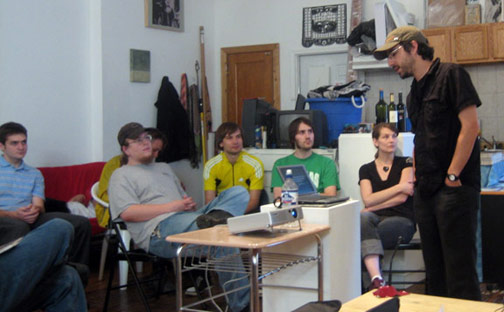
photos from Xabier Barandiaran's talk


5 : : : P O L V O : : :: June 2006

Wednesday, June 07, 2006

Xabier Barandiaran @ polvo

**ARTIST TALK**

INFRASTRUCTURE SERIES :
"Hackmeeting and Hacklabs: technopolitics and reality hacking in
south-european autonomous networks"

Presenter: Xabier Barandiaran - Series Talk #2
Monday June 12, 7-9pm, FREE ADMISSION

Polvo - 1458 W. 18th St. 1R | Chicago IL | www.polvo.org
Co-Sponsored by AREA Chicago Art/Education/Activism and CriticalArtWare
www.areachicago.com | www.criticalartware.net

For the last 6 years a number of autonomous collectives called HackLabs (hacker or hacktivist laboratories) have been created at different squat social centers and other self-managed spaces around europe. The network of hacklabs has now more than 40 nodes (most of them located in Spain and Italy) dedicated to build-up community based free-software and open access spaces for skill sharing and collective intelligence, technopolitic experimentation and direct action on several digital struggles (cybercontrol, digital rights, intelectual property, etc.). HackLabs were born as a result of Hackmeetings: underground self-organized hacktivist meetings where grassroot activist and geek culture meet to discuss, exchange and coordinate different knowledge, resources and initiatives around technologies and politics. The talk will focus on a set of trajectories within the hacklabs and hackmeeting networks: the experience of Metabolik (one of the first hacklabs in europe), the distributed and self-managed organization of spanish and european hackmeetings and the recent direct action campaing against intellectual property (CompartirEsBueno.Net). Emphasys will be made on philosophical background, discussion on technopolitical tactics and opportunities for coordination. http://hacklabs.org

Presenter Bio
Xabier Barandiaran is a PhD student and researcher on Cybernetics, Neurophilosophy and Artificial Life at the University of the Basque Country (Europe), member of the autonomous server SinDominio.Net, the hacktivist laboratory Metabolik BioHacklab (located at the social squat center Undondo Gaztetxea), the spanish and european HackLabs.Org network and the recent copyleft activist campaing "CompartirEsBueno.Net" (SharingIsGood: a spanish network of hacktivists and media-activists against intelectual property regimes and the media-culture industry). He has also been involved on other grassroots movement such as alternative education, social desobedience, anti-war movements and squatting. Xabier has also co-organized and activelly participated on a number of HackMeetings (self-managed technopolitical meetings that take place in squatted social centers in europe), Copyleft Conferences and other parallel events, workshops and seminars. His work has been devoted to development and promotion of free-software tools for social movements, direct action and coordination of autonomous technopolitical networks as research on free technologies & culture, community based digital self-management and hacktivism.

About the INFRASTRUCTURE SERIES:
AREA's ongoing and irregular "Infrastructure" series, which will continue with meetings, screenings, shows, dinners, writings, readings over the next few years. The framework of the series will focus on the questions of longevity, sustainability, institution building, and mutual aid relationships involved in the process of creating self-organized infrastructure. To imagine an existence beyond the rent gap speculation, beyond the non-profit (NGO) industrial-complex and beyond the academy - we must imagine another Infrastructure!

AREA Chicago is a biannual publication focusing on the intersections of Art/Education/Activism in the city of Chicago. The website is currently having technical difficulties but is generally available at www.areachicago.com

ABOUT criticalartware:
criticalartware is an [application/platform/concern] compiled at the turn of the twenty first century to address hyperthreaded hystories of new media, [software-as-art/art-as-software] and [connections/ ruptures/dislocations] between early moments of {conceptual|code}- based art forms such as artware and Video Art. By drawing [parallels/ paths] between the [concepts/discourses] of these early moments, criticalartware hopes to critically question and [re]connect the current context to its rightful unruley past: a multitude of [personal/subjective] hyperthreaded [her/hi/hy]stories. http://criticalartware.net


Polvo
1458 W. 18th St. 1R
Chicago, IL 60608
773.344.1940
http://www.polvo.org
Hours: Saturdays from Noon-5pm or by appointment
5 : : : P O L V O : : :: June 2006 **ARTIST TALK** INFRASTRUCTURE SERIES : "Hackmeeting and Hacklabs: technopolitics and reality hacking in south-european autonomous netw...

The Chicago Eccentrics

THE SCHOOL OF PANAMERICAN UNREST Arriving in Chicago!
The School of Panamerican Unrest is an artist-led, not-for profit public art project that seeks to generate connections between the different regions of the Americas through discussions, both short-term and long-term collaborations between organizations and individuals.

The project also seeks to involve a wide range of publics and engage them at different levels in a dialogue about alternative ways to understand the history, ideology, and lines of thought that have significantly impacted in the political, social and cultural events in the Americas.

Its main component is a nomadic forum or think-tank that is crossing the hemisphere by land, from Anchorage, Alaska, to Ushuaia, Argentina (Tierra del Fuego). This hybrid project includes a collapsible and movable architectural structure in the form of a Schoolhouse, as well as a video and book collection component inside the van in which the journey is being made.

On each of its stops, the SPU will offer a number of public programs in collaboration with its host.

CHICAGO PANEL
At each stop, the School will facilitate a discussion/roundtable with local participants on a subject that is of both local and Panamerican relevance. The discussions will be summarized in the daily blog, and papers and other information will be posted on the main website (www.panamericanismo.org).

MUSEUM OF CONTEMPORARY ART, 220 East Chicago Ave. (Tel. 312-280-2660)
Saturday, June 10th at 2:00 pm, FREE ADMISSION

The Chicago Eccentrics
Moderators: Pablo Helguera and Encarnacion Teruel

John Corbett, Professor, SAIC, Co-director, Corbett vs. Dempsey Gallery
Ed Marszewski, Executive Director Version Festival, Lumpen Magazine
Tony Fitzpatrick, Artist, Entrepreneur
Ruth Lopez, Art & Design Editor, Timeout Chicago
Elvia Rodriguez, Visual artist, Co-Founder, Artist Collective POLVO
5 : : : P O L V O : : :: June 2006 THE SCHOOL OF PANAMERICAN UNREST Arriving in Chicago! The School of Panamerican Unrest is an artist-led, not-for profit public art project t...
<