Propagation: curated by Sabrina Raaf
Artists:
Industry of the Ordinary
Patrick Lichty
Andrea Polli
subRosa
Michael Workman
Amy Youngs
also a mini exhibit: Christa Donner
Opening Friday October 13 from 6pm-10pm
October 13 - November 4, 2006
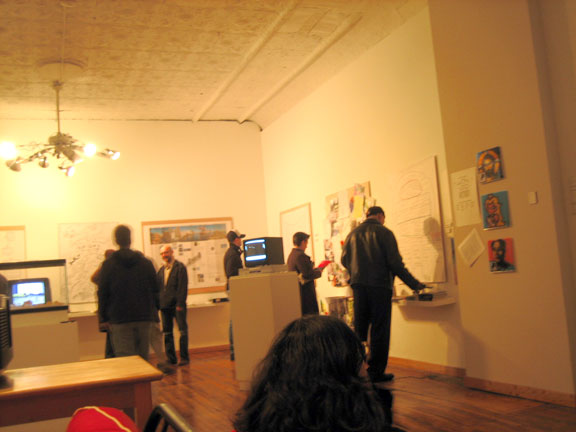
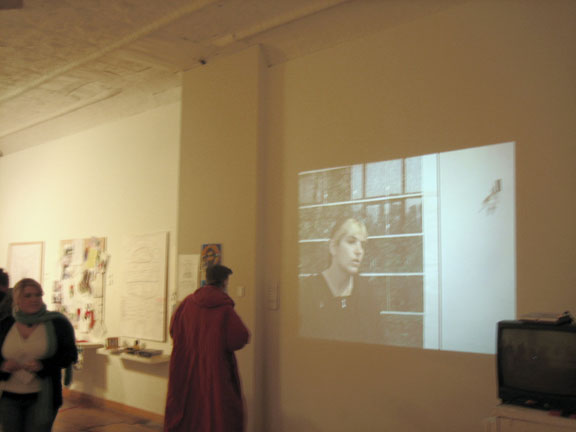
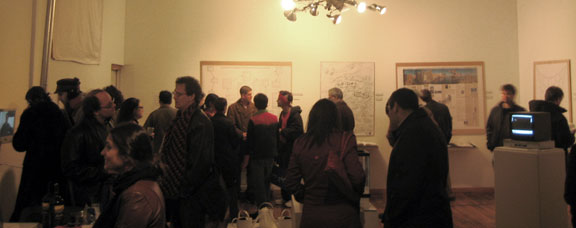
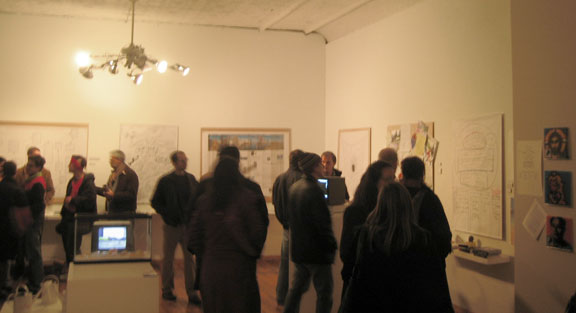
Propagation is an exhibition about artists, art writers, and curators who bypass traditional exhibition systems (eg. galleries, museums, magazines, etc.) by creating their own methods and systems for distributing their art or message. But more essentially, it's about how these culture authors' unique systems of dispersion may - in and of themselves - be considered as art. On view are diagrams generated by each exhibitor that map out aspects of their methodology, network, and organizational patterns. Also on display are video interviews with the exhibitors, documentation of their works as well as actual works, and distributive ephemera (pamphlets, cds, and other materials). This exhibition offers an opportunity for audiences to examine the shape and phenomena of these art generation, systemization, and distribution methodologies as art forms and end products - not just as production engines.
Whether they are formulating new parameters for the way art might look, the places it might be found, how it may be defined and who gets access to it, these exhibitors are all actively repositioning the artist - and art itself - in society today. They focus on issues of sustainability and renewable materials, such as found in the Queensbridge Wind Power Project by Andrea Polli and in Prototypes for Hermit Crab Shells by Amy Youngs. They also distribute their message on a street level - directly to the public - in an unfiltered, often unsolicited manner such as in the interventionist works of Industry of the Ordinary. They proliferate their messages through subversive tactics including skillful questioning of the intersections of info- and bio-tech on women’s bodies and work - such as found in the pamphlets, websites, videos and performances of subRosa. Last, they function as cultural agents and art system generators who continuously transfigure with ease and purpose between capacities such as artist, editor, author, critic, curator, art fair director [Michael Workman] and artist, activist, editor-in-chief, author, engineer, curator, and collaborator [Patrick Lichty].
This evolution of new art systems / practices / means / and methods is being designed in part out of necessity. The platforms of white-box galleries and glossy magazines can be too shallow, too focused, too irrelevant to the public, and/or too short term for the edgier concepts that culture authors seek to communicate. In other words, if culture authors wish to be world changing, than they need access to more powerful propagation systems in order to make their messages heard. Furthermore, the lack of funding for the arts in America has caused a real attrition in the numbers of experimental art spaces willing to host boundary-pushing works. Many artists unwilling to work more traditionally are therefore faced with the imperative to evolve the systems around them or to catalyze new ones.
I would like to thank the collective of Polvo for their 10+ years of fostering experimental arts in Chicago via exhibitions, listservs, web and print publications. The Propagation exhibition at Polvo is a demonstration of how non-profit organizations remain invaluable sites for presenting convention-breaking art to interested audiences.
Sabrina Raaf
artist, curator, Propagationist
About the curator:
Sabrina Raaf is a Chicago-based artist working in experimental sculptural media and photography. Her work has been presented in solo and group exhibitions at Mejan Labs (Stockholm), Wendy Cooper Gallery (Chicago), Espace Landowski (Paris), Ars Electronica (Linz), Opel Villas Foundation Art Center (Rüsselsheim), Artbots 2005 (Dublin), Stefan Stux Gallery (NYC), San Jose Museum of Art, Museum Tinguely (Basel), Kunsthaus Graz, ISEA (Helsinki), Klein Art Works (Chicago), Wynick/Tuck Gallery (Toronto) and Painted Bride Center (Philadelphia). She is the recipient of a Creative Capital Grant in Emerging Fields (2002) and an Illinois Arts Council Fellowship (2005 & 2001). Reviews of her work have appeared in Art in America, Contemporary, Chicago Tribune Sunday Magazine, Leonardo Magaine, www.lab71.org, The Washington Post, and New Art Examiner. She received an MFA in Art and Technology from the School of the Art Institute of Chicago and is currently an Assistant Professor in the School of Art and Design at the University of Illinois at Chicago.
Artist Bios: Amy Youngs - http://accad.osu.edu/~ayoungs/
Amy M. Youngs creates mixed-media, interactive sculptures and digital media works, that explore the complex relationship between technology and our changing concept of nature and self. She has exhibited her works nationally and internationally at venues such as Springfield Museum of Art (Springfield, OH), Pace Digital Gallery (New York, NY), the Biennale of Electronic Arts (Perth, Australia), John Michael Kohler Arts Center (Sheboygan, Wisconsin), Circulo de Bellas Artes (Madrid, Spain), the Visual Arts Museum (New York, NY) the Art Institute of Chicago's Betty Rymer Gallery, Vedanta Gallery, Northern Illinois University Art Gallery (Chicago, IL), the San Francisco Public Library, Blasthaus, (San Francisco, CA) and Works (San Jose, CA). Her artwork has been reviewed in publications such as, The Chicago Sun Times, The Chicago Reader, San Francisco Bay Guardian, RealTime and Artweek. Youngs has published several essays, including one on genetic art in the journal Leonardo and another on art, technology and ecology in the international art publication Nouvel Objet in 2001. She has lectured on her work widely, including at the California State University, Long Beach, the Massachusetts Institute of Technology (Boston, Massachusetts), the Australian Center For the Moving Image (Melbourne, Australia) and the Perth Institute for Contemporary Art (Perth, Australia) and has participated in panels at conferences such as the Women’s Caucus for the Arts, the College Arts Association and the Biennale for Electronic Arts in Australia. Youngs is currently an Assistant Professor of Art and and the Art and Technology Program in the Department of Art at The Ohio State University. She was born in 1968 in Chico, California.
Andrea Polli - http://www.andreapolli.com/
Andrea Polli is a digital media artist living in New York City. She is currently an Associate Professor of Film and Media at Hunter College and received a Master of Fine Arts in Time Arts from the School of the Art Institute of Chicago. Polli's work addresses issues related to science and technology in contemporary society. Her projects often bring together artists and scientists from various disciplines. She is interested in global systems, the real time interconnectivity of these systems, and the effect of these systems on individuals. She has exhibited, performed, and lectured nationally and internationally.
She is currently working in collaboration with meteorological scientists to develop systems for understanding storms and climate through sound. For this work, she has been recognized by the UNESCO Digital Arts Award 2003 and has presented work in the 2004 Ogaki Biennale in Gifu, Japan and at the World Summit on the Information Society in Geneva, Switzerland. Her work in this area has also been presented at Cybersonica at the ICA in London and awarded funding from the New York City Department of Cultural Affairs and the Greenwall Foundation. As a member of the steering committee for New York 2050, a wide-reaching project envisioning the future of the New York City region, she is currently working with city planners, environmental scientists, historians and other experts to look at the impact of climate on the future of human life both locally and globally.
She has recently presented the installation and digital print project The Fly's Eye, (2002) which creates a live movement and light analysis and deconstruction of the video image, at Le Centre de production DAÏMÕN in Quebec, the Politecnico di Milano University in Milan, Italy, at The Kunstgewerbe Museum in Berlin, Germany, at The Aronoff Center in Cincinnati, OH, at Apex Gallery in New York City, at the V Salón y Coloquio Internacional de Arte Digital in Havana, Cuba, and at SIGGRAPH '03 in San Diego among other venues.
Polli's longest running performance project, Intuitive Ocusonics, a system for performing sound using eye movements, began in 1996 and has been shown at V2 in Rotterdam, Holland; at the N-Space Art Gallery of SIGGRAPH '01 in Los Angeles, CA; at the Subtle Technologies Conference at the University of Toronto, Canada; and at Immedia, at the University of Michigan. Other performances and presentations include: The Monaco Danses Dances Forum, Monaco; ISEA, International Symposium on Electronic Art, Paris France; Invencao, Sao Paolo; and Imagina 98, Monaco. To support this work and the production of an Audio CD, Active Vision, she was awarded a 1999 artist's residency at The iEAR Institute at Rensellaer Polytechnic, a Harvestworks Recording Production Grant in New York, an Artist's Residency at The Center for Research in the Computing Arts at The University of California at San Diego, and a residency at Franklin Furnace in New York as part of The Future of the Present. She has also shown this work in venues throughout New York City, Chicago and the Midwest; in San Francisco, and in Finland, Iceland, Germany, Sweden, Greece, and the Phillipines.
Her performance work and research is documented in the article Active Vision in the October 1999 issue of The Leonardo Journal. A retrospective article about her work from 1991-1998, Virtual Space and the Construction of Memory, is published in the Spring 98 issue of The Leonardo Journal.
Industry of the Ordinary - http://www.industryoftheordinary.com/
Through sculpture, text, photography, video, sound and performance Industry of the Ordinary are dedicated to an exploration and celebration of the customary, the everyday, and the usual. Their emphasis is on challenging pejorative notions of the ordinary and, in doing so, moving beyond the quotidian.
Industry of the Ordinary were formed in 2003. Their first performance, Dropping 163 lbs: Daley Plaza, involved approximately 75 performers who dropped 163 lbs of white clothing on Daley Plaza in Chicago. 163 lbs is the average weight of an American adult.
subRosa - http://www.cyberfeminism.net
subRosa’s name honors feminist pioneers in art, activism, labor, science, and politics: Rosa Bonheur, Rosa Luxemburg, Rosie the Riveter, Rosa Parks and Rosie Franklin.
subRosa is a reproducible cyberfeminist cell of cultural researchers committed to combining art, activism, and politics to explore and critique the effects of the intersections of the new information and biotechnologies on women’s bodies, lives, and work.
subRosa produces artworks, activist campaigns and projects, publications, media interventions, and public forums that make visible the effects of the interconnections of technology, gender, and difference; feminism and global capital; new bio and medical technologies and women’s health; and the changed conditions of labor and reproduction for women in the integrated circuit.
subRosa practices a situational embodied feminist politics nourished by conviviality, self-determination, and the desire for affirmative alliances and coalitions.
Michael Workman - http://www.bridgemagazine.org/online/
Michael Workman is the President and Director of Bridge NFP, a Chicago-based 501 (c) (3) organization. Workman is President of the Bridge Art Fair, an international exposition of new art that hosts large-scale exhibitions in Chicago, Miami and London. Bridge manages commercial leases for several properties in Chicago, including the Network of Visual Art space at 840 West Washington and unit 3D at 119 North Peoria, providing affordable studio and exhibition space to dozens of individual artists, graphic designers and gallery/artist-run spaces including Bucket Rider, F2 Lab and Garden Fresh. Workman writes a column on visual art, Eye Exam, for the Chicago alternative weekly NewCity, serves as Chicago correspondent for the bi-monthly Italian art publication, Flash Art and the UK-based art magazine Contemporary. Workman regularly lectures at The School of The Art Institute of Chicago, Northwestern University, Columbia College Chicago and the University of Illinois at Chicago. His writing has appeared in catalog essays for the Chicago Cultural Center and his fiction, journalism and critical writing has appeared in New Art Examiner, The Chicago Reader, zingmagazine and elsewhere.
Patrick Lichty - http://www.badideamachine.com/lichtyfolder/ and http://www.voyd.com/voyd/
Patrick Lichty (b. 1962, Akron, Ohio) was born into a family with a long involvement in and support of the arts. His mother, a exhibiting artist of numerous art and craft media, immersed him in textiles, painting, ceramics, print and other techniques during his upbringing. Simultaneously he was also exposed to technology in the form of the emerging genres of electronics, video games, and later personal computing when his parents bought him an Atari 800 computer in 1978. Instead of following the desires of many adolescents of the late 70's in wanting to program the next Pac-Man or Space Invaders, he was interested in drawing and creating music with his personal computer.
Upon graduation from high school, family convinced him that computers and electronics was a field with great potential. Lichty then followed this advice to complete two degrees in electronic engineering at the University of Akron (Ohio, US), but also followed studies in Art and Asian Studies. In addition, free time was devoted to continuing interests in design, painting and digital imaging.
In 1990, while studying postgraduate Glass and Art History at Kent State University, Lichty met theatre historian Leigh Clemons and Sociologist Jonathon Epstein. Clemons would later become Lichty's scholarly collaborator (and spouse), and Epstein became partner in the media group, Haymarket Riot. During the first half of the 1990's, Lichty and Epstein created a number of works on media and culture, including Americans Have No Identity, but they do have Wonderful Teeth, The Sociology of Jean Baudrillard, and Haymarket Riot's MACHINE.
By the mid 1990's, the World Wide Web burst upon American culture, and advances in personal media production allowed the individual to create media art available only to institutions. From this, early web artworks following his love of art and theory, such as (re)cursor and video like Haymarket Riot's WEB were created, which caught the attention of corporate activists cum art group RTMark. From the mid 90's to the early 00's, the critical work started with Haymarket Riot continued in collaboration with RTMark in creating visuals and animation for exhibitions and video, culminating in 1999's Bringing It to YOU!, which was featured in the 2000 Whitney Biennial.
Solo work continued as well, exploring the nature of narrative structure in online spaces. These include 1998's Metaphor and Terrain, a 'sculptural' essay examining interface as art object, 1999's Grasping @ Bits, another hyperessay looking at issues of art and intellectual property rights, and 2000 Smithsonian American Art Museum commission SPRAWL: The American Landscape in Transition. This last piece consisted of a hyperdocumentary consisting of over 190 minutes of interviews, various texts, and 32 panoramic vistas of areas in his home town of North Canton, Ohio that were in the midst of rapid change due to the housing boom of the late 90's.
After 2000, Lichty's artistic and scholarly practice would further expand from solo and collaborative works to include numerous curatorial projects, including (re)distributions: Mobile Device and PDA Art, columnist for ArtByte Magazine, and the assumption of the Executive Editor position at Intelligent Agent Magazine (NYC), in partnership with Whitney Museum of American Art digital arts curator, Christiane Paul. In addition, his service to the New Media community also expanded by becoming Chair of the Inter-Society of Electronic Art's (ISEA's) Cultural Diversity Committee, and Executive Curator of Microcinema International's Mobile Exposure cellphone video festival.
In 2001, the RTMark visual collaborations would catch the attention of another activist group, The Yes Men. This group's comical stunts, calling for humane treatment of global populations by organizations such as Dow Chemical, EXXON, the US Government, and the WTO, were featured internationally from ArtNews to the BBC. Lichty's slapstick animations from bizarre management schemes to fast-food waste reclamation projects were core illustrative components of the group's presentations, and featured in Bluemark's documentary, The Yes Men, which showed at the Sundance, Berlin, and Sydney film festivals.
After over a decade in the New Media art world, a desire share his experience through teaching required that Lichty seek a terminal (MFA) degree. In 2004, he entered Bowling Green State University's Digital Arts program under advisor Gregory Little. While planning to graduate in 2006, Lichty has served as Representative-at-Large for BGSU Graduate Student Senate, the BGSU Public Arts Committee, and is member of Phi Kappa Phi with a 4.0 GPA. He remains in his former duties, and is most recently featured in the exhibition, Dreaming of a More Better Future, at the Cleveland Institute of Art with Kevin and Jennifer McCoy and Vito Acconci.
Polvo
1458 W 18th Street 1R(entrance on Laflin St.)
Chicago, IL 60608
773-344-1940
hours: saturdays from noon-5pm or by appointment
This exhibit is part of Chicago Artists Month, the eleventh annual celebration of Chicago’s vibrant visual art community. In October, 250 exhibitions of emerging and established artists, openings, demonstrations, tours, open studios and neighborhood art walks take place at galleries, cultural centers and arts buildings throughout the city. For further information, call 312/744-6630 or visit www.chicagoartistsmonth.org. Chicago Artists Month is coordinated by the Chicago Department of Cultural Affairs.