Friday, December 29, 2006

Propagation show in Chicago Reader's 2006 Top 10 Art Exhibits

Critic's Choice 2006 Top Ten exhibits
By Bert Stabler
December 22, 2006

My top ten choices acknowledge some exciting trends in Chicago art. One is the new emphasis on Afro-Futurism, which synthesizes traditional designs and media, psychedelic mysticism, current technology, and utopian politics. Then there are the new breeds of artists and curators exploring unusual media, staging "interventions" (often socially committed work created or displayed in public places, not galleries), and exhibiting in individuals' apartments and yards, introducing a welcome spontaneity and vulnerability.


"Pathways to Unknown Worlds" at the Hyde Park Art Center, October 1-January 14, 2007
John Corbett's collection of written and visual artifacts documents the iconography of utopian mystic/jazz auteur Sun Ra, highlighting his stunningly creative, searing artistic and political statements. The excellent auxiliary programs devoted to his legacy should go a ways toward making Afro-Futurism a household word.


Nick Cave: Soundsuits at the Chicago Cultural Center, April 22-July 9

African-inspired rococo costumes for dancers by SAIC fashion department chair Nick Cave constituted the most singularly striking collection of figurative mixed-media sculptures you were likely to see this year without going to Wisconsin to see Tom Evermore's giant scrap-metal ostriches.


D. Denenge Akpem, part of the 12 x 12 New Artists/New Work series at the Museum of Contemporary Art, June 3-July 2

Imaginative Nigerian-born performance, video, installation, and fiber artist D. Denenge Akpem explored her ancestry and femininity in an array of traditional and high-tech media, using imagery drawn from fairy tales and surrealism. Her inspiring, colorful show included fiber-optic jellyfish, chalk wall drawings referencing Italo Calvino, and flower-shaped chairs.


Undergraduate exhibition at SAIC Gallery 2, April 2-14

This annual show should never be overlooked -- by dint of sheer volume and energy, there's always fantastic work to be seen. Most of the best items this year involved fake animals.


Sabrina Raaf at Wendy Cooper, April 28-June 3

Sabrina Raaf's altered digital photos of magical interiors combined a blank Ikea aesthetic -- empty white rooms with blond-wood floors -- and Robert Longo-style figures in gravity-defying poses. Raaf showed some ingenious robotic contraptions as well. Wendy Cooper has exhibited other sexy work this year: the scary wall art of Belgian artists Aline Bouvy and John Gillis in September was cool too.

"Propagation" and Christa Donner at Polvo, October 13-November 4

Curator Sabrina Raaf's "Propagation" consisted of video, sound, and print documentation of work created or exhibited outside the gallery system. Amy Youngs described on video, for example, her creation of sculpted shells for hermit crabs (they don't have their own and rely on castoffs). A minishow by Christa Donner showed she's branching out in her reconceptualizations of the body: she's been photographing performances in which people are wearing her drawings of cut paper, colored pencil, and other media -- yarn, paint, glitter. See the show ONLINE HERE.


Version>06 at Iron Studios and elsewhere, April 20-May 7

The Version festival -- just over two weeks of installations, events, exhibits, performances, talks, tours, and workshops -- emphasizes video, electronics, and other new media and adds preoccupations with activism, partying, and their hybrid offspring, interventions. Signal examples were the "art shanties" originally constructed by the Soap Factory collective for Minnesota ice fishermen, offering activities from karaoke to building pinhole cameras.


"Hot and Ready" by Melinda Fries et al, in public and private spaces around Walnut and Damen, October 1

This was more a one-day street party than a proper show -- the antique art term is happening. Highlights included a mobile inflated ball roughly the size of a two-story building, a semifunctional full-scale catapult, a climbing wall constructed from old stuffed jeans, scrounged trophies (including plush Japanese "husband" dolls), and a great potluck spread.


Scott Treleaven at Kavi Gupta, October 20-November 25

Founder of the legendary queer/punk/pagan zine This Is the Salivation Army, Scott Treleaven primarily showed nostalgic-erotic pieces combining picturesque flora and fauna, Victorian morbidity, and hot young satyrs in a mix of watercolor and collage.

California Occidental Museum of Art: COMA 5, July 15

This incarnation of the museum's one-night-only apartment-gallery group show offered a well-coordinated vision of messing with space. Annika Seitz's minimal orange Hello Kitty-ish Ganesh figures, Mike Wolf's Eminent Domain sawhorse legs, and Mindy Rose Schwartz's creeping macrame lattice were all high points.
Wednesday, December 20, 2006

our new year begins January 12, 2007


Familiar Portraits
Photo installation by Edra Soto

also this month:
mini exhibit: Adriana Baltazar
flatscreen video: Josue Pellot


Opening Friday January 12 from 6pm-10pm
January 12- February 3, 2007

One way of acquiring an immediate sense of ownership to space, person and moment you are living in life is the simple action of taking a picture of it.

A way to review our tendencies, impulses or compulsions is by going in retrospect and examining our past approaches. In Familiar Portraits, Edra Soto examines the ordinary process of taking pictures of things we love; our pets, our babies, possessions, etc. and project a view on how we reclaim things in life; our sense of ownership.

For this sociological approach, the artist invited a group of friends and family to participate in this visual survey. Soto asked them to donate pictures they have taken of their beloved ones (pets, babies, etc).

All their contributions constitute her personal narrative of what "familiar" means.

Familiar Portraits is presented as an installation (narrow space defined by two walls inside the gallery space) displaying a series of photo collections interrelated by the artist. Some of the photographs are perceptive and others are fictional representation. The fictional representations are digital manipulations created by the artist and are integral to the narrative of this project. In Familiar Portraits, Soto utilize hierarchical classifications, proportions and sets to create visual and organizational schemes.

Soto's interest in classic subjects like portraits, still lifes and landscapes have led her to a personal questioning about the social concept of family, extended families, the people or animals we live with, who we love and why.

Edra Soto was born in San Juan, Puerto Rico in 1971. In 1995 Edra received the Alfonso Arana Fellowship to work in Paris, France for a year. She attended The School of the Art Institute of Chicago where she obtained her Masters degree in 2OOO. Immediately after, she attended a 2 months residency at Skowhegan School of Painting and Sculpture. She has exhibited in Puerto Rico, Paris, Australia, Spain, Russia, New York, St Louis, Milwaukee and Chicago. Some of her latest presentations include a live performance at El Museo del Barrio in New York, a solo show and live performance at El Museo de Arte de Puerto Rico, UIC Gallery 4OO, NIU Museum in Chicago, and Polvo in Chicago. A solo show of her latest instalation will be on view at Polvo, Chicago on January of 2OO7.

Download Edra's CV here
see more at www.edrasoto.blogspot.com


mini exhibit: Adriana Baltazar
Born in southwest Chicago, Adriana Baltazar has grown up to be a near hermit. By night, she is drawing away and by day working in an office to pay off art school debt. As a child she searched for stray pets to nurture and now it appears she is the stray. Find her wandering streets and woods seeking sublime inspiration and escape in vacant lots or other plots of dirt overridden with trees and foliage. For this show she will create a wall size pencil drawing. She explains: "Theres a nice correlation between the impermanence of pencil as a medium and the imminent temporary existence of many vacant lots in our neighborhood. A gallery space in itself is much like an empty lot, impermanent and ever-changing with every exhibit. If I put up objects., ie paintings, viewers can assume that after the exhibit was over, I'd take them back or install them at a new space. The pencil as a medium stills seems to convey a sense of fragility, that it will be erased, replaced. That it is unfinished."
flatscreen video: Josue Pellot

Having been born in Puerto Rico (Mayaguez - wearing bell-bottoms) but raised in the U.S. since the age of five, traveling back and forth from the Island and Chicago, Josue feels that he's somewhere between these two cultures, probably in the Bahamas. Josue (ho.sway, ho.sue.ehh) - grew up between Humboldt Park and Logan square where he was introduced to art thru Graffiti and Hip Hop. He went to Kelvyn Park High School on Chicago's northwest side and then received a BFA with a minor in Biology from the University of Illinois at Chicago. Despite all this, he was awarded an MA from Northwestern University in Art Theory and Practice (the theory being if you practice, you'll improve - thus he keeps trying!). He's now a Chicago-based artist and works in various mediums.

POLVO
1458 W. 18th St. 1R
Chicago, IL 60608
polvoarte@yahoo.com or 773 344 1940
http://www.polvo.org
HOURS: Saturdays from Noon-5pm or by appointment

Tuesday, December 19, 2006

Jóvenes latinos exhiben en Polvo


La Raza
Publicado el 12-18-2006

Jóvenes latinos exhiben en Polvo

Joana Arellano está todavía en la secundaria y Carlos Terrazo se graduó el año pasado, sin embargo, estos jóvenes artistas ya están exhibiendo, en la galería Polvo de Pilsen, su instalación titulada: “Nuestras historias en palabra e imagen”.


Mercedes Fernández
La Raza


Son dos jóvenes promesas del arte latino que han tomado la ruta del arte para expresar las inquietudes propias de su generación, así como los temas que les preocupan como miembros de la comunidad latina.

Joana, quien nació en este país y sus padres son inmigrantes mexicanos, vive en el barrio de La Villita y estudia el cuarto año en la secundaria Whitney Young.

“Siempre me ha gustado el arte, veo que es una manera en la que podemos expresar nuestras opiniones, emociones y también crear un cambio social”, dice la joven artista.

Dalí, Caravaggio, Frida Kahlo, André Breton son, entre otros, los artistas que más admira Joana, quien realizó su formación artística en Gallery 37, Marwen, Universidad de Illinois en Chicago y también en su escuela secundaria.

El trabajo realizado por estos jóvenes artistas latinos consiste en una instalación en la que se puede apreciar un mural en acrílico con paisaje de montañas donde escribieron la palabra “journey”, así como fotografías y códices elaborados por inmigrantes que participan en los programas de arte de la Coalición de Inmigrantes Africanos, Árabes, Asiáticos, Europeos y Latinos de Illinois (CAAAELI) y Citizenship and Voter Training School (CIVITAS).

“La instalación se enmarca dentro de la exhibición de Michael Capapas, quien es un artista filipino y trata sobre el problema de la inmigración y la identidad”, dijo Jesús Macarena Avila, artista, curador, educador y co-fundador de la Galería Polvo.

Gracias a su invitación, los jóvenes latinos tienen la oportunidad de exhibir su trabajo que incluye las fotos que resultaron de un taller sobre el tema de inmigración organizado por CAAAELI, así como códices, o códigos, elaborados a mano por los participantes, los cuales tienen como tema central la inmigración y el viaje.

A partir de estos conceptos, los artistas desarrollan un trabajo que invita a la reflexión sobre el significado de la frontera o las fronteras desde la perspectiva inmigrante “que puede ser la frontera de los Estados Unidos, o la frontera dentro de la familia cuando se confrontan la generación de padres inmigrantes con los hijos nacidos en este país”, acotó Macarena Avila.

Joana, quien afirma haber recibido siempre el apoyo de su familia, maestros y amigos asegura ser una buena estudiante en la escuela y espera ingresar a la Universidad de Illinois en Urbana – Champaign para estudiar arte y sociología el año que viene.

Por su parte, Carlos Terrazo se graduó de la secundaria Farraguit en junio pasado. Actualmente estudia en el Harold Washington College y trabaja como coordinador de juventudes en el Comité de Desarrollo de La Villita.

La mini-exhibición de los artistas latinos se presenta simultáneamente con la exposición de Michael Capapas, artista nacido en Filipinas de padres inmigrantes establecidos en Melbourne, Australia. Egresado del Victorian College for the Arts, Capapas se vinculó con Macarena Ávila durante un viaje de trabajo que llevó a este último hasta Melbourne.

Esta será la primera individual de Capapas en los Estados Unidos en la que mostrará un trabajo que toca el tema de la inmigración en Australia.

“Ésto es probablemente porque una gran parte de mi vida la he pasado viviendo en lugares donde sentía que no pertenecía. Siendo un inmigrante del norte, he sido un extraño en el sur”, dijo Capapas antes de partir para Australia la semana pasada.

La exhibición, que se inauguró el 6 de diciembre, culminará el 30 de este mes. La galería de arte Polvo está ubicada en el 1458 de la Calle 18 en Pilsen. © La Raza

Now the giant faces really are watching

Critics say Millennium Park cameras are a blight
By James Janega
Tribune staff reporter

Published December 19, 2006

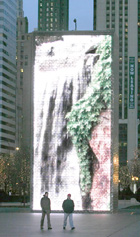
What strikes you about Jaume Plensa's twin glass towers at Millennium Park are the faces, as big as JumboTrons, that appear to be looking at you.

And since late November, they actually have been.

A $52 million grant from the Department of Homeland Security bought the Chicago area a host of public safety improvements--including an obvious and ungainly camera atop each of Plensa's giant glass towers.

The city that put cameras in crime-ridden areas and at intersections to catch red light scofflaws has planted them atop Crown Fountain, one of its most prominent pieces of public art.

They are partly to keep tabs on burnt-out lights, park officials say. But the cameras are largely for security reasons, and art lovers don't like it.

"Oh my God, look at that. Not very pretty," said Paul Gray, a director at the Richard Gray Gallery in Chicago who has worked with Plensa on other exhibitions, as he looked at a photograph of the cameras online.

"It looks like a Martian sitting there with a little antenna on his head," said art and architecture enthusiast Mike Doyle, whose partner took the photograph.

"It is a temporary fix, so we can get a permanent solution installed next summer," said Ed Uhlir, Millennium Park executive director.

"But it is ugly," he agreed.

A permanent camera will go on a pole west of the fountains next summer, roughly where speed chess players set up their table on the sidewalk at Monroe Street and Michigan Avenue, said Millennium Park spokeswoman Karen Ryan.

Critics say the temporary ones cannot be temporary enough. "That is one of those `What were they thinking?' kind of moments," said James Yood, professor of art history at the School of the Art Institute of Chicago.

"This changes the whole idea of the sculpture, which is that these are our brethren," Yood said. "Now instead of looking at us, they're surveilling us, which I think is not exactly the artist's intention."

The cameras have created a stir since being installed around Thanksgiving, with versions of the following scene playing out downtown:

"We were walking down Monroe towards Michigan Avenue to go for a walk in the park. Then we got to the corner and noticed it," said Devyn Caldwell, a Loop resident and architecture photo blogger.

Next to him, Doyle looked up and saw it too.

"The first thing I see is these little black things sticking out," said Doyle, also a blogger. Their Sunday walk screeched to a halt as they stared. "I said `What in the world is tha--?' But as soon as the question was out, we knew right away."

Chicago is dotted with cameras. They roll near public housing complexes and videotape dangerous intersections around the city.

Mayor Richard Daley announced in October that he wants to add 100 police cameras to high-crime streets, expanding a camera system the city credits with 30 percent drops in local crime. There are already 200 cameras on the street, many with large, blinking blue lights.

The cameras at Millennium Park are almost as obvious but at least do not blink. And they haven't recorded anything unusual yet, said Ryan.

Though they will be relocated, setting them up on the sculpture was easier than putting in a new pole for them, she explained.

"This was a way to get them up there," she said.

Plensa, who is in Spain, could not be reached for comment Monday. Uhlir said Millennium Park cleared the cameras' addition with the architects who worked with Plensa on installing the fountain. The final cameras, assured Uhlir, "will be much less intrusive."


------------------
and later today....

Millennium Park cameras removed after outcry

By James Janega
Tribune staff reporter
Published December 19, 2006, 12:24 PM CST


Millennium Park officials early today took down a pair of security cameras atop Jaume Plensa's glass-block video fountains, removing what art aficionados decried as intrusions in a prominent piece of downtown public art after the Chicago Tribune wrote about their concerns.

"When we found out there were so many people who found it more obtrusive than we expected, we took them down," said park spokeswoman Karen Ryan.

The cameras were installed as part of a $52 million Department of Homeland Security grant to the Chicago area, and the cameras atop the Plensa-designed Crown Fountain were only two out of about 10 in Millennium Park alone, city officials said.

But their location irked the artistically-minded, and bloggers began writing about and posting pictures of them online over the weekend.

The Tribune was the first to mention the aesthetic concerns to park managers, Ryan said. "Then we looked around for it (criticism) and we found it, found the blogs."

Plensa, reached in Spain by Chicago gallery contact Paul Gray, was relieved they were taken down, Gray said.

"He's happy that they've decided to seek a better long-term solution — and he understands the need for security in a public space," Gray said. "He and I have both worked in the public space a lot, and are aware that when you put art in a public space, it does belong to the public. You hope the city will be respectful."

The city was, he added. The problem was not with cameras per se, only with where they were located.

"People have to know that they're there to be useful, but that doesn't mean it needs to be on the nose of a sculpture," Gray said.

Copyright © 2006, Chicago Tribune


a call for artists

echelon: who is watching you?
August 3 - September 1, 2007


"One cannot use spies without sagacity and knowledge, one cannot use spies without humanity and justice" - Sun Tzu

"It was terribly dangerous to let your thoughts wander when you were in any public place or within range of a telescreen. The smallest thing could give you away. A nervous tic, an unconscious look of anxiety, a habit of muttering to yourself..anything that carried with it the suggestion of abnormality, of having something to hide. In any case, to wear an improper expression on your face.. was itself a punishable offense."
- George Orwell, 1984, Book 1, Chapter 5


US surveillance began centuries ago with the concept of slave passes, which allowed slave-owners to monitor and control the mobility of their "chattel." Yet the slave pass system was sometimes subverted by the rare slaves who could write, such as Frederick Douglass. These literate slaves could create their own passes and might thus gain freedom for themselves and other slaves. Trafficking in passes and "free papers" soon became a burgeoning business, one that the slave system grappled with for nearly two centuries.

From slaves, the history of surveillance next turns to the infamous Chinese Exclusion Act of 1882, which restricted Chinese immigration to the United States. All Chinese laborers were forced to register with the government and subject themselves to being photographed and fingerprinted. A whole apparatus of surveillance was created.

In the 1920s, government surveillance spread to political radicals, especially workers trying to organize union activity. J. Edgar Hoover headed this government surveillance unit which would later become the FBI. As the 20th century advanced, computer technology proved a powerful enhancement to the regime of surveillance. This allowed most devices and databases to be monitored and evaluated, including automobiles, Your car can be tracked by GPS, and your spending habits can be gleaned from accessing your credit card records. Internet and email are monitored in the workplace and cameras are just about everywhere.

For this show artists will explore the history of surveillance and how this affects us at this present time. They will in turn create work dealing with this theme which will include 2D work, installation, and new media.

OPEN TO USA ARTISTS
DEADLINE JAN 31, 2007

Requirements:
1. Send a couple of jpegs of the type of work that you do along with a short one paragraph Bio and CV(in word or PDF format). If you do video then send links to any online work.

2. Write a short one paragraph statement about the work you would like to create that deals with the theme.

3. The show takes place in Chicago so any work that is selected from another city must be easy, small and cheap to transport via UPS, FEDEX or Postal Service (you ship it to Chicago and we pay for the shipping back). We do not receive any funding from the government and we do not have insurance. But in the 10 years of organizing shows nothing has ever been stolen or damaged.

For more info: http:// www.polvo.org/echelon.html

EMAIL: info@polvo.org

ABOUT POLVO:
Polvo is an alternative space located in Chicago's Pilsen neighborhood and is operated by the artist collective Polvo, originally formed in 1996. Polvo's history consists of organizing artistic and cultural venues with Chicago / Pilsen-based community spaces. In addition to venues, the collective generated a magazine focused on arts and culture followed by an online website that initiated an international array of visual artists, writers, and cultural critics (Polvo maintained a Pilsen gallery space in 1999). Since February 2003, the collective has been organizing and curating art exhibits at the Polvo space where we showcase contemporary art including installation projects, new media and performance by a diverse group of emerging and established artists.

Sunday, December 10, 2006

Timeout Magazine review

“Rooted in Tradition”

Mexican Fine Arts Center Museum, through Sun 10.

-4 stars-
from Timeout Chicago

The altar on display here for Chicago police officer Eric Solorio, who was killed earlier this year while on duty, has the traditional elements used in celebrating the Mexican Day of the Dead: food to feed the soul on its long journey (tamales), something to drink along the way (Patrón tequila) and personal items so the dead know they are remembered (shoes, a Loyola mug, a toy police car and a video montage).

The holiday is rooted in an ancient Aztec tradition that was combined with the Christian holidays All Souls’ Day and All Saints’ Day to save it from eradication by invading Spaniards. Solorio’s memorial shows the way time continues to round the edges off of the ceremony by incorporating a flat-screen monitor and a Starbucks cup.


In a separate room, an altar for Michael Piazza, a local artist who also passed away earlier this year, was assembled by his friends at Polvo, the nearby art collective and gallery space, who take a more creative approach. Touching on one of Piazza’s favorite sayings (“You spend the first half of your life groovin’ and having fun…and the second half looking for a good mattress”), they put a mattress on top of a bed of his favorite books. It’s far more warm and engaging than a tombstone or a starchy wake.

This exhibit features other altars as well, alongside paintings and sculptures that explore the holiday’s other elements, predominantly skulls and skeletons.—Josh Tyson

Tuesday, December 05, 2006

an evening of films created by Shikshantar Andolan

Join Twine for an evening at Polvo, "Re-membering Nai Taleem".., an evening of films created by Shikshantar Andolan, The Peoples Institute for Rethinking Education and Development. This is an abbreviated version of the full festival, which is happening concurrently in India.

Friday: December 15th: 7:15pm
FREE ADMISSION

We hope that these films can invigorate our ideas about education.

Program:

  • Mera Atma Shikshak, Mera Karma
    Director: Vidhi Jain, Pravin Pagare, Tushar Kulkarni, Pannalal Patel
    Length: 68 minutes
    Language: Hindi With English Subtitles

    This film takes us into a profound conversation with Dayalchand Soni, a Gandhian educational thinker. Soni's wisdom challenges us to rethink some of our most basic assumptions around education while deepening our understanding of the possibilities that lie in nai taleem.

  • Children Being In the World
    Director: Amit, Manish, Jinan KB
    Length: 5 minutes
    Language: Music with English subtitles

    This Film explores natural learning ecologies of children living in non-letterate communities in India. What have we lost by distancing ourselves from Nature? How can we remember our biological instinct for learning?

  • Colors of Devotion
    Director: Suny Gandhrva and Ramawtar Singh
    Length: 28minutes
    Language: Hindi with English subtitles

    For hundreds of years, In The town of Nathdwara, Rajastan there has lived a community of artists connected to the temple of Shreenathji. Generation after generation has devoted itself to the Pichhwai art form. Now this learning community is struggling to keep the essence of its art alive in the face of modernity. Their experiences can help broaden our visions of education.


  • Cycle Yatra
    Length: 5minutes
    Language: music with English subtitles

    A group of friends travels on bicycles in Mewar, Rajastan India for one week using no money.


    Discussion and Response: We would love to hear your stories of integrated learning and we aim to create a spontaneous and informal response video to mail back to Shikshantar as a kind of exchange.

Download more info here

Polvo
1458 W. 18th Street 1R
Chicago (entrance on Laflin side)
www.polvo.org
773.344.1940

Twine International is a not for profit in process committed to promoting art, ecology and social justice through ethical enterprises and integrated learning. If you are interested in learning more, contact Amy Mall at: premelamall@yahoo.com